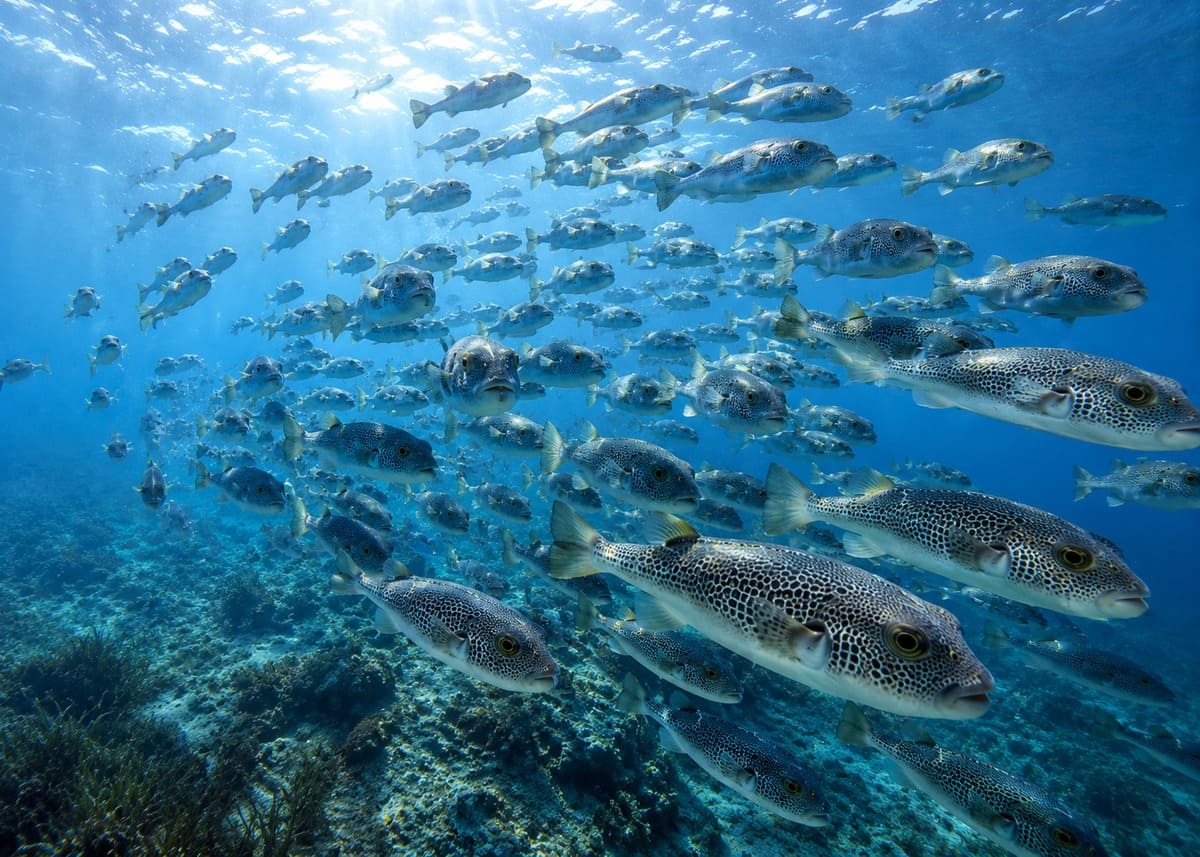
Few invasive marine species have spread through the Mediterranean as rapidly and caused as many ecological and economic concerns as the silver-cheeked toadfish (Lagocephalus sceleratus).
Originally native to the Red Sea and the western Indian Ocean, this species entered the Mediterranean through the Suez Canal and has expanded steadily across the basin over the past two decades.
For most people, the silver-cheeked toadfish is known as a poisonous fish that should never be consumed. For professional fishers, however, it represents something far more tangible: damaged fishing gear, destroyed catches, lost income and an increasingly difficult working environment.
Today, the species is considered one of the most significant invasive marine fish affecting the eastern Mediterranean and continues to expand westwards.
🐟 Silver-Cheeked Toadfish at a Glance
|
Item |
Information |
|
🌍 Native Range |
Red Sea & Indian Ocean |
|
☠️ Hazard |
Highly toxic |
|
🍽️ Edible |
❌ No |
|
📈 Status |
Rapidly expanding in the Mediterranean |
|
🧬 Scientific Name |
Lagocephalus sceleratus |
What Is the Silver-Cheeked Toadfish?
The silver-cheeked toadfish belongs to the family Tetraodontidae (pufferfishes) and is regarded as one of the most successful invasive marine fish established in the Mediterranean Sea.
Its natural distribution includes the Red Sea and the western Indian Ocean. The species entered the Mediterranean through the Suez Canal, following the migration route of Lessepsian species.
Following the expansion of the Suez Canal in 2015, the spread of several invasive marine species accelerated. ALKIA considers that the absence of a comprehensive environmental impact assessment contributed to underestimating the long-term ecological consequences for the Mediterranean ecosystem.
Today, the silver-cheeked toadfish is well established throughout much of the Eastern and Central Mediterranean, with records continuing to increase further west.
⚠️ Quick Facts
|
Question |
Answer |
|
Is it dangerous? |
✔ Yes. It contains the powerful neurotoxin tetrodotoxin (TTX). |
|
Does it attack people? |
❌ No. It is not aggressive towards humans but may bite if handled. |
|
Can it be eaten? |
❌ No. Consumption may be fatal. |
|
Why is it a problem? |
It damages fisheries, threatens marine biodiversity and has very few natural predators in the Mediterranean. |
|
Where does it live? |
Coastal waters, rocky reefs, sandy bottoms and seagrass meadows throughout the Mediterranean. |
Why Is the Silver-Cheeked Toadfish So Dangerous?
The silver-cheeked toadfish is considered one of the most problematic invasive marine species in the Mediterranean for several reasons.
It combines a highly effective predatory behaviour with one of the most potent natural neurotoxins known to science.
Its success as an invasive species is mainly due to the following characteristics:
It contains tetrodotoxin (TTX), an extremely powerful neurotoxin.
It possesses four strong fused teeth forming a hard beak capable of crushing shells, cutting fishing lines and damaging nets.
It reproduces efficiently and adapts to a wide range of marine habitats.
It has very few natural predators in the Mediterranean.
It feeds on numerous commercially and ecologically important marine species.
Together, these characteristics make the silver-cheeked toadfish one of the most successful marine invaders in the Mediterranean Sea.
How to Identify the Silver-Cheeked Toadfish
Correct identification is essential for both public safety and scientific monitoring.

📋 Species Profile – Lagocephalus sceleratus
|
Feature |
Information |
|
Common Name |
Silver-cheeked Toadfish |
|
Scientific Name |
Lagocephalus sceleratus |
|
Family |
Tetraodontidae |
|
Category |
Invasive Marine Species (Lessepsian migrant) |
|
Native Range |
Red Sea & Western Indian Ocean |
|
Introduction Pathway |
Suez Canal |
|
Mediterranean Distribution |
Eastern and Central Mediterranean, expanding westwards |
|
First Record in Greece |
2005 (South-Eastern Aegean Sea) |
|
Maximum Length |
Up to 120 cm |
|
Maximum Weight |
More than 10 kg |
|
Diet |
Fish, crustaceans, cephalopods and molluscs |
|
Natural Predators |
Very few in the Mediterranean |
|
Toxicity |
Extremely high (Tetrodotoxin – TTX) |
|
Edible |
❌ No |
|
Commercial Trade |
Prohibited for human consumption within the European Union |
Tetrodotoxin (TTX): One of Nature’s Most Powerful Neurotoxins
The silver-cheeked toadfish contains tetrodotoxin (TTX), one of the most potent naturally occurring neurotoxins known to science.
Interestingly, the toxin is not produced by the fish itself. Instead, it originates from specific marine bacteria associated with the species through the food web. Over time, tetrodotoxin accumulates in various organs, particularly the liver, ovaries, skin and intestines, although small amounts may also be present in muscle tissue.
TTX blocks sodium channels in nerve cells, preventing normal nerve signal transmission. In severe poisoning cases, this may lead to muscle paralysis, respiratory failure and, without prompt medical care, death.
There is currently no specific antidote for tetrodotoxin poisoning. Treatment focuses on supportive hospital care until the toxin is naturally eliminated from the body.
☠️ Tetrodotoxin (TTX) at a Glance
|
Feature |
Information |
|
Type |
Powerful neurotoxin |
|
Produced by |
Marine bacteria (bioaccumulated through the food chain) |
|
Main organs affected |
Nervous system |
|
Highest concentrations |
Liver, ovaries, skin and internal organs |
|
Antidote |
❌ None currently available |
|
Medical treatment |
Supportive hospital care |
Is the Silver-Cheeked Toadfish Dangerous to Humans?
Yes—but not because it attacks people.
The silver-cheeked toadfish is not an aggressive species. It does not actively attack swimmers or divers. The danger comes from two distinct risks:
accidental consumption of its toxic flesh or organs;
bites sustained while handling the fish.
Although human poisoning cases are relatively uncommon, consuming the fish may cause severe intoxication and can be fatal.
For this reason, the sale and commercial distribution of Lagocephalus sceleratus for human consumption is prohibited throughout the European Union.
What Happens If You Eat a Silver-Cheeked Toadfish?
Symptoms usually appear within 10 minutes to several hours after consumption, depending on the amount of toxin ingested.
Early symptoms may include:
numbness around the lips and tongue;
tingling sensations;
nausea and vomiting;
dizziness;
difficulty speaking.
More severe poisoning may progress to:
muscle weakness;
loss of coordination;
paralysis;
respiratory failure.
Immediate medical attention is essential whenever poisoning is suspected.
🚑 Suspected Tetrodotoxin Poisoning
|
Step |
Action |
|
1 |
Call emergency medical services immediately. |
|
2 |
Do not wait for symptoms to worsen. |
|
3 |
Inform healthcare professionals that tetrodotoxin poisoning is suspected. |
|
4 |
Keep the patient calm while awaiting medical assistance. |
Can the Silver-Cheeked Toadfish Bite?
Yes.
The silver-cheeked toadfish possesses four fused teeth forming an exceptionally strong beak capable of crushing shells, sea urchins and hard-bodied marine organisms.
Most bite injuries occur when professional or recreational fishers attempt to remove the fish from hooks, fishing lines or nets.
Bites may cause:
deep lacerations;
heavy bleeding;
tendon injuries;
nerve damage.
For this reason, direct contact with the fish’s mouth should always be avoided, even if the fish appears dead.
🚑 What Should I Do If I’m Bitten?
|
Step |
Action |
|
1 |
Move away from the fish safely. |
|
2 |
Apply firm pressure to control bleeding. |
|
3 |
Rinse the wound thoroughly with clean water. |
|
4 |
Seek prompt medical evaluation, particularly if the wound is deep or bleeding heavily. |
Impact on Greek Fisheries
For many professional fishers, the silver-cheeked toadfish is no longer simply an invasive species—it has become part of everyday working life.
The species damages fishing nets, longlines and catches, increases operating costs and reduces income for coastal fishing communities.
In several regions of Greece, fishers report catching dozens of silver-cheeked toadfish during a single fishing trip, particularly during the warmer months. Many commercially valuable fish are also found partially eaten before the fishing gear is retrieved.
As a result, the species has become one of the most significant economic challenges facing small-scale fisheries in the Eastern Mediterranean.
How Can Citizens Help?
Managing invasive marine species is not solely the responsibility of scientists or public authorities. Citizens, divers, recreational fishers and professional fishers all play an important role in protecting the Mediterranean.
Every verified observation contributes to a better understanding of the species’ distribution and supports more effective management strategies.
ALKIA encourages public participation through Citizen Science, enabling everyone to contribute valuable information to marine conservation efforts.
🌍 Citizen Science
|
Step |
Action |
|
📸 1 |
Photograph the fish, if it is safe to do so. |
|
📍 2 |
Record the location or GPS coordinates whenever possible. |
|
📝 3 |
Report the observation through a recognised invasive species monitoring platform. |
|
🤝 4 |
Help improve scientific knowledge and long-term monitoring of Mediterranean ecosystems. |
Economic Impact on Fisheries
Scientific studies conducted by the Hellenic Centre for Marine Research (HCMR) have documented the significant financial burden that the silver-cheeked toadfish places on professional fisheries.
Research led by Dr Konstantinos Kapiris estimates that annual losses for a single small-scale fishing vessel may exceed €7,000, including:
damaged fishing gear;
destroyed catches;
increased operating costs;
additional labour time;
reduced fishing efficiency.
In areas where populations are particularly dense, the economic impact may be even greater.
📊 Main Economic Impacts
|
Impact |
Consequence |
|
Damaged fishing nets |
Increased repair and replacement costs |
|
Destroyed catches |
Reduced marketable fish |
|
Longer working hours |
Lower operational efficiency |
|
Higher fuel consumption |
Increased fishing costs |
|
Reduced annual income |
Financial pressure on coastal fisheries |
Management Challenges
Controlling the spread of the silver-cheeked toadfish requires more than financial compensation schemes.
An effective management strategy also depends on:
coordinated monitoring;
efficient collection systems;
cold-chain logistics;
safe transportation;
environmentally sound disposal methods;
rapid administrative procedures;
long-term funding.
Without these elements working together, large-scale management programmes remain difficult to implement.
Greek Scientific Research & Monitoring
Major Scientific Research on the Silver-cheeked Toadfish in Greece
Scientific research carried out in Greece has significantly advanced our understanding of the biology, ecology and socio-economic impacts of the silver-cheeked toadfish (Lagocephalus sceleratus), one of the Mediterranean’s most problematic invasive marine species.
Among the most important Greek scientific contributions are the following:
University of Ioannina
Professor Ioannis Leonardos and his research team have contributed extensively to the study of non-indigenous fish species in Greek waters, with particular emphasis on fish ecology, biological invasions and their impacts on Mediterranean ecosystems. Their work provides valuable scientific evidence supporting the development of effective management strategies for invasive marine species.
Hellenic Centre for Marine Research (HCMR)
Several studies conducted by researchers at the Hellenic Centre for Marine Research (HCMR) have documented the rapid expansion, biology and ecological impacts of Lagocephalus sceleratus in Greek waters. Their work has substantially improved scientific knowledge of the species’ distribution, population dynamics and interactions with Mediterranean ecosystems.
University of Thessaly and collaborating Greek research institutions
Research undertaken by Greek universities and collaborating institutions has examined the ecological, fisheries and socio-economic impacts of the silver-cheeked toadfish, including damage to fishing gear, losses to professional fisheries and the public health risks associated with tetrodotoxin (TTX). These studies provide an important scientific foundation for management measures and policy development across the Eastern Mediterranean.
ALKIA Scientific Note
This section will be updated regularly as new scientific studies become available.
ALKIA continuously follows research conducted by Greek universities and research institutions, with particular interest in the work of Professor Ioannis Leonardos (University of Ioannina) and other scientists whose research contributes to a better understanding of invasive marine species and supports evidence-based policies for the protection of Mediterranean biodiversity.
ALKIA Position
The silver-cheeked toadfish is not only an environmental issue. It is a test of our ability to combine science, experience and innovation into practical solutions.
Scientific knowledge already exists.
Professional fishers understand the problem better than anyone.
Modern technology offers powerful new tools.
What is needed is effective collaboration.
ALKIA was established to bring together scientists, fishers, divers, citizens, institutions and artificial intelligence into a shared ecosystem where knowledge becomes coordinated action.
ALKIA Vision

The Mediterranean does not need isolated initiatives.
It needs long-term cooperation.
It needs reliable scientific knowledge.
It needs coordinated action.
ALKIA was created to help make that collaboration possible.
Protecting the Mediterranean is not the responsibility of a single organisation.
It is a shared mission.
And every great mission begins when people decide to work together.
Sources & Scientific Documentation
🟡 Field Observations
- Observations by divers, fishermen and marine scientists throughout the Eastern Mediterranean.
🟢 Scientific Literature
- Peer-reviewed publications on Lagocephalus sceleratus
- Scientific studies on lionfish ecology, invasion biology and management in the Mediterranean Sea.
🔵 Official Databases
- EASIN (European Alien Species Information Network)
- ELNAIS (Hellenic Network on Aquatic Invasive Species)
- CIESM
- IUCN
ALKIA Living Article
First published: 8/7/2026
Last updated: 12/7/2026
Current version: 1.4
📚 Related Living ALKIA Articles
🌊 The Suez Canal: The 2015 Expansion and the Mediterranean’s New Ecological Reality
Explore the history of the Suez Canal, the 2015 expansion, Lessepsian Migration and the emerging scientific questions shaping the future of the Mediterranean.
🦁 Lionfish: Beautiful in Appearance, Challenging to Manage
Discover the biology of the invasive lionfish, its impacts on Mediterranean marine ecosystems and the role of responsible consumption in supporting sustainable population management.